
Weight transfer: what movement reveals
Transferring an avatar’s weights to clothing can be painstaking even by hand, depending on the item.
Nearest vertex, nearest-face interpolation and voxel heat diffusion are familiar options in major 3D applications. I tested them on garments to see how far they could support a fully automatic workflow.
My test model combined a multilayer top—with a T-shirt, collar and double pockets—and wide trousers with only a 2 mm gap between the legs at the hems. It brought several difficult conditions together.
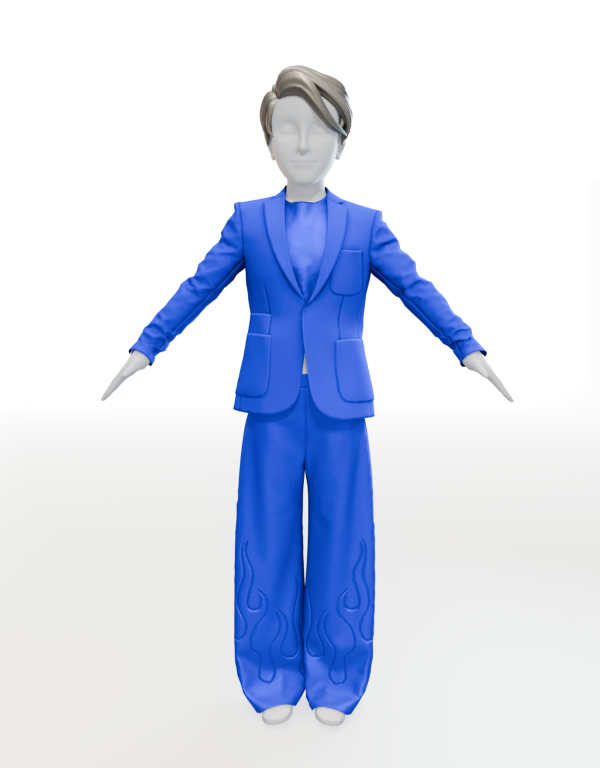
The A-pose model used as the starting point for comparison.
Nearest Face Interpolation
The calculation was simple and intuitive, working well with close-fitting clothing and multilayer meshes. Concave areas were more troublesome: vertices assigned to the wrong bone stretched visibly during animation.
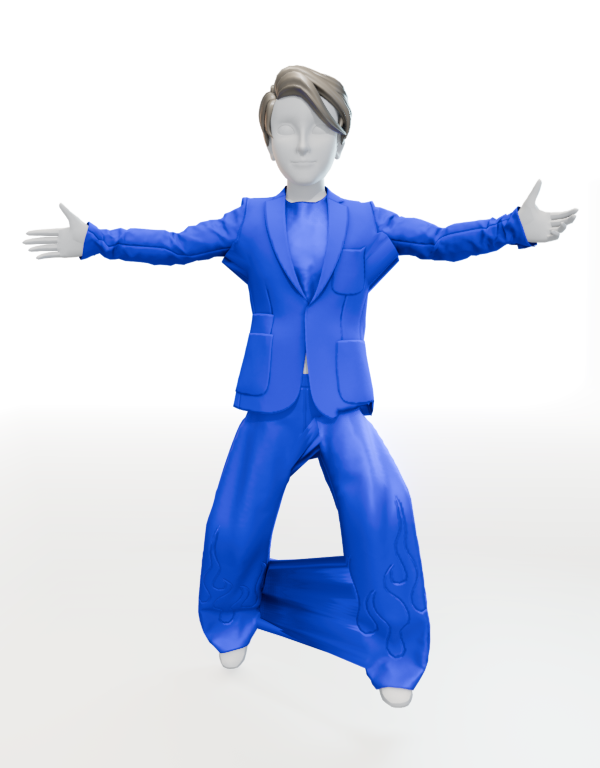
The trouser hems stick together, making the failure conspicuous in motion.
Voxel Heat Diffusion
This method voxelizes the garment and spreads weights like heat. Because it does not directly transfer between nonadjacent parts, I hoped it would reduce confusion between limbs and the torso.
Transitions between joints became smoother, but their extent was hard to control. The method did not preserve the body’s existing weights as well as I needed, and the gap between the legs remained a problem.
It seemed more suitable when both avatar and garment still needed rigging than for this task of transferring from an already-rigged body.
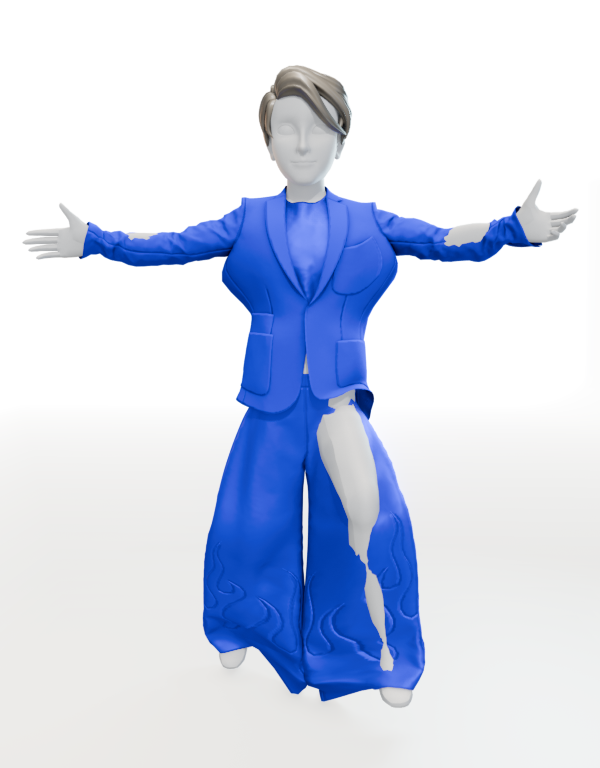
The trousers take on a hakama-like shape.
Corrective Smooth Baker as post-processing
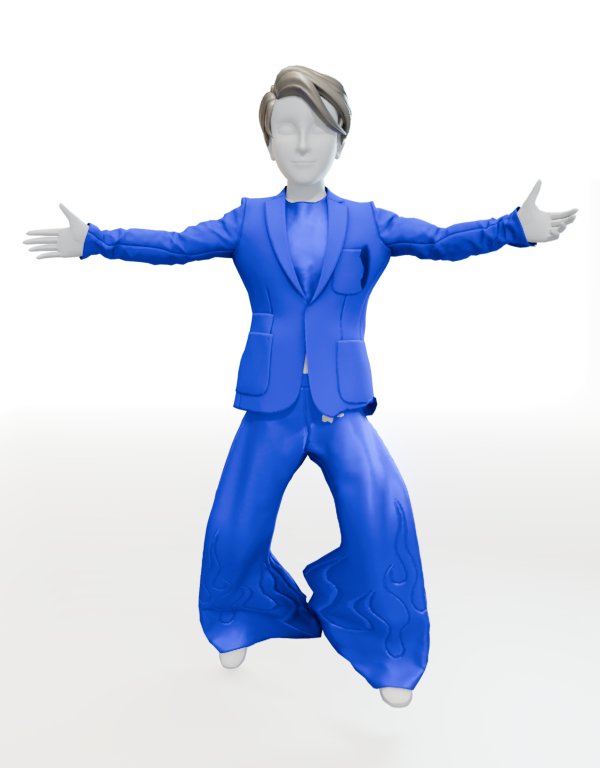
After nearest-face interpolation, I used Corrective Smooth to identify excessive deformation and group weights to correct assignments. Sticking was reduced, but the weights of overlapping fabric layers lost consistency.
Developing my own approach
Adjacent Over-deformed Refinement
I tried recursively identifying excessive deformation and replacing weights from continuous neighboring mesh regions. This resolved the sticking between the legs.
Prioritizing continuity introduced another problem. The chest of a female character could be treated like two legs that should separate, breaking consistency instead. Attached pieces such as pockets could also fly away from the garment surface.
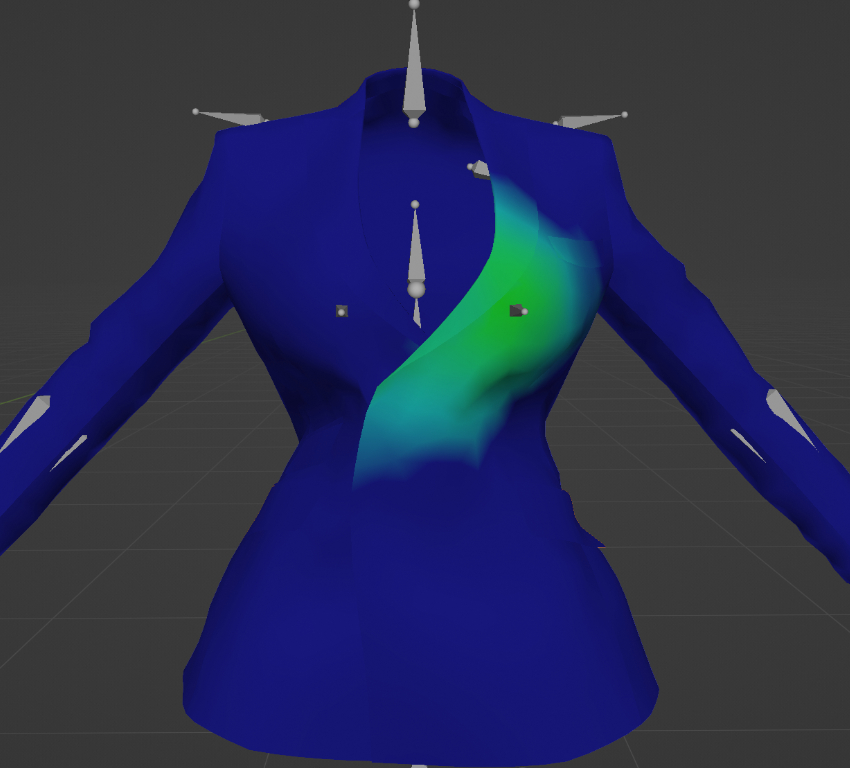
The overlapping double-breasted construction also lost coherence.
Bi-directional Segment Projection
With this approach, I could finally transfer weights without sticking even where the hems nearly touched. Joint softness was more faithful, execution stayed short, and attached parts retained continuity with the garment.
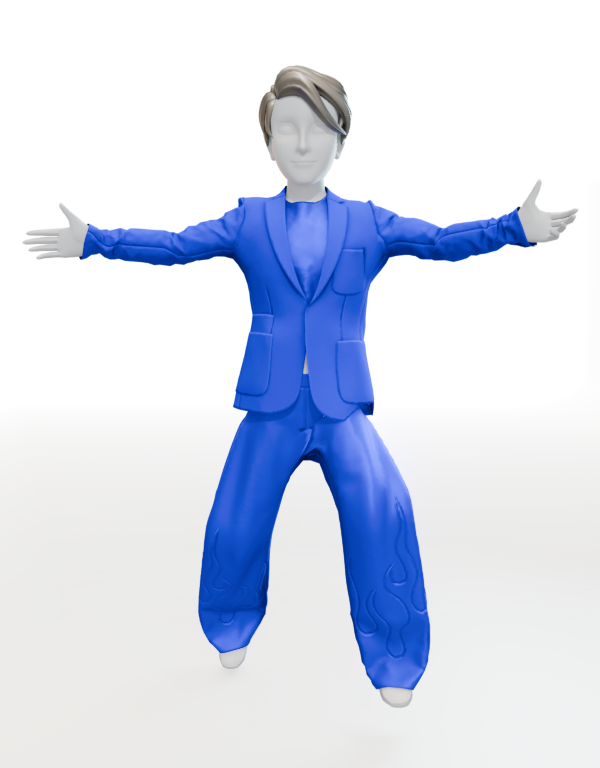
Connecting these stages produced an automated pipeline from CAD garments to metaverse assets. In my original account, I described the work as removing the equivalent of more than 70 hours of manual work per item. Handling geometry, materials and motion together was the destination of this trilogy.
An example with motion from Mixamo.
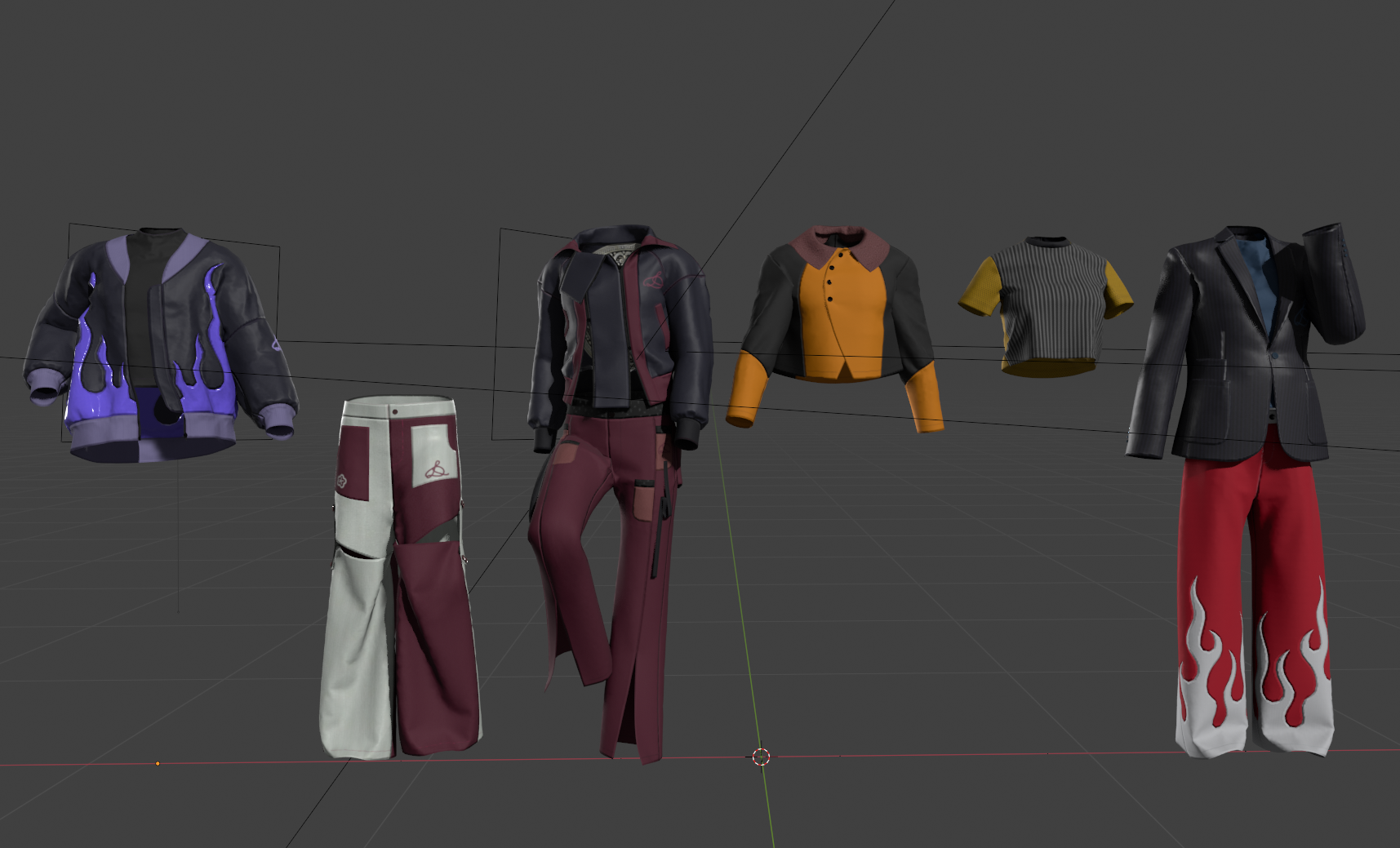
Turning DMKTZ designs into clothing usable as UGC.
For more digital fashion, visit DMKTZ’s official Instagram.
Peace.