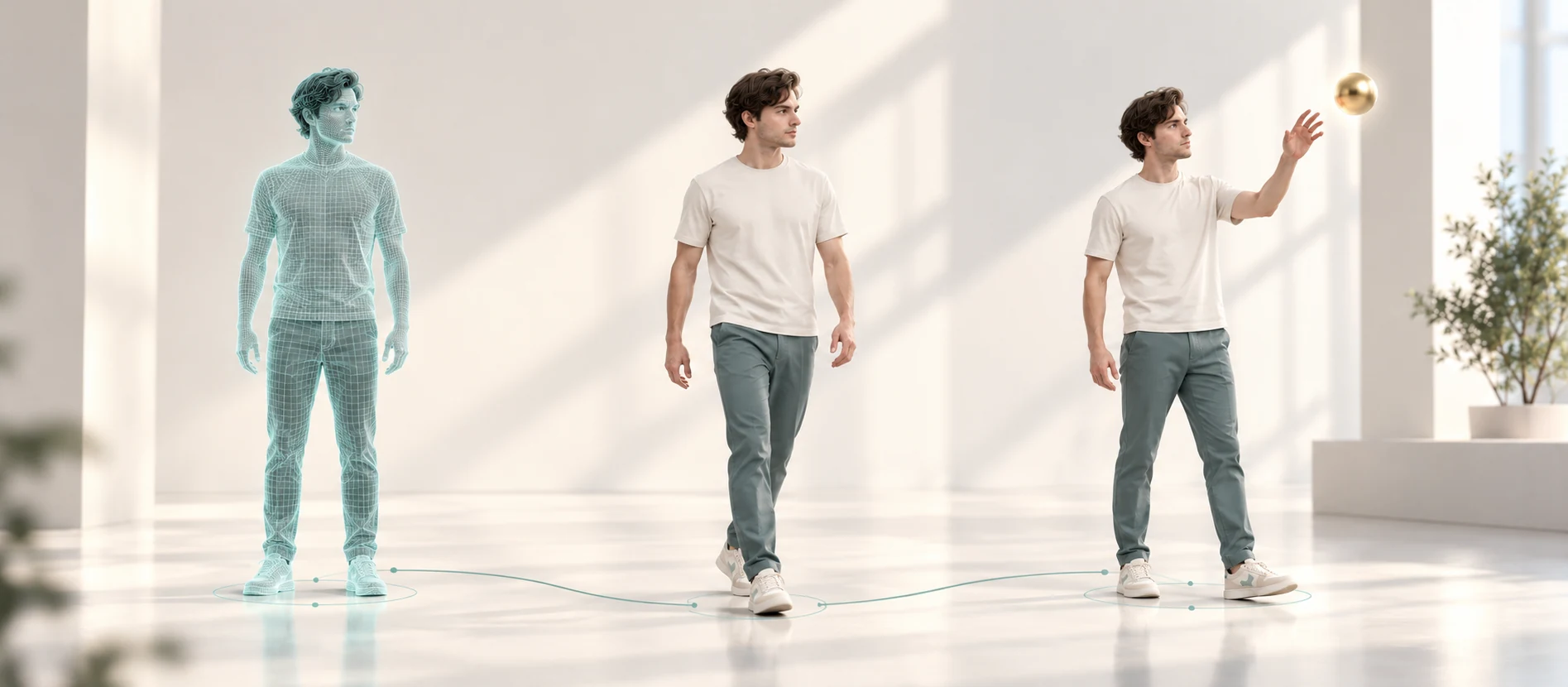
Mobile Scan has made a digital body easier to obtain. Where could we take it next? I want to explore avatars that have motion and a relationship with their surroundings, beyond displaying a static shape.
This extends my LiveAvatar/QM application work in try-on and virtual spaces. What follows is the next direction I want to investigate with AI motion generation.
Having a shape and being able to move
Obtaining a body from photographs and making it move are different tasks. Similar-looking bodies can have different joint mappings and reference poses. Passing the same motion data between them does not guarantee the intended result.
I want to preserve both body characteristics and the intent of a movement. That means checking ground contact, interactions and scale in the environment, beyond whether the character appears to walk.
Three motion tools, viewed through their uses
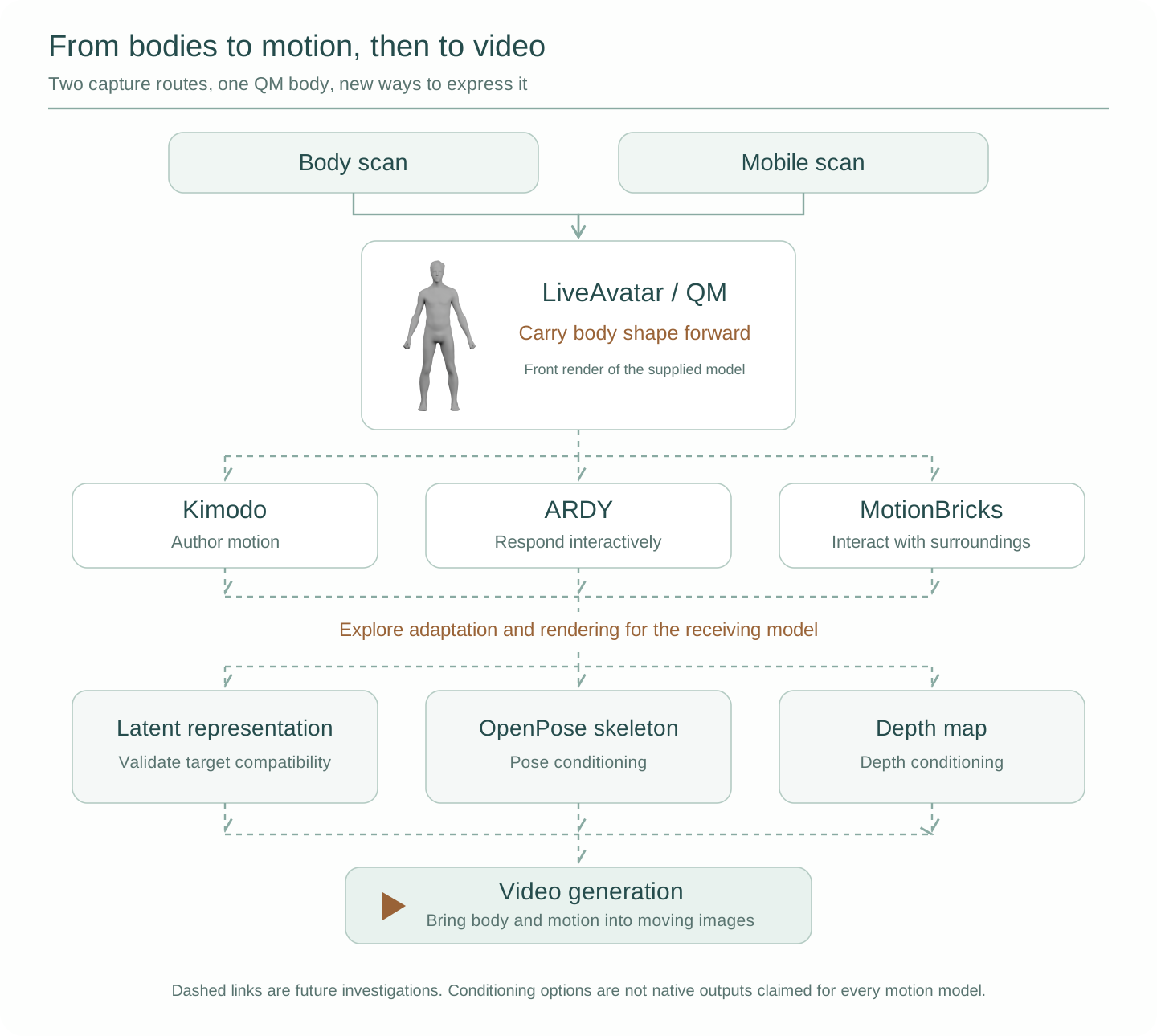
NVIDIA’s Kimodo creates 3D motion from text and constraints. ARDY addresses interactive generation as instructions change. MotionBricks connects movement through target poses and interactions with objects.
I would begin with three needs: authoring motion, reacting to input and interacting with surroundings. Choosing what the avatar should do makes the purpose of an integration clearer.
Compatibility must be checked after conversion
Kimodo provides models for different body representations. That does not establish a direct connection to a QM avatar.
I want to check joint correspondence, reference pose, scale, contact and the body’s appearance in motion, along with the chosen model version and applicable usage terms. Going through SMPL or MHR also requires checking the result, rather than treating conversion itself as proof of quality.
I would start by comparing short standing, walking and sitting motions on the same avatar. This is the evaluation I want to undertake next.
Turning body and motion into video conditions
The next path I want to explore brings a QM body from a body scan or Mobile Scan together with AI-generated motion, then into video. After adapting motion to the body, I would like to use an OpenPose skeleton or depth as conditions for video generation. A latent representation would likewise need to suit the receiving model.
I see Kimodo, ARDY and MotionBricks as candidates to choose according to the experience. I want to test whether the body's character and the intent of the motion survive into video, rather than assume that the models can share the same latent representation directly.
What I mean by a digital twin
An animated avatar does not automatically reproduce that person’s own movement. A generated walk is different from a recording of how the person actually walked.
What I want from a digital twin is a body representation that can be updated for a purpose while keeping observations distinct from estimates and generated behavior. Trying on clothing, joining a virtual space and understanding one’s body require different information. I want the person to retain a choice over presentation and use.
The question behind Privacy Scan—how do we want our bodies represented?—continues here. That is the direction I want to take beyond Mobile scan.
The body series
Privacy Scan — How do we want our bodies represented?
The banner is an AI-assisted concept illustration of a future connection between bodies and motion, not the output of an integration with a particular motion model. The diagrams also explore future applications.